
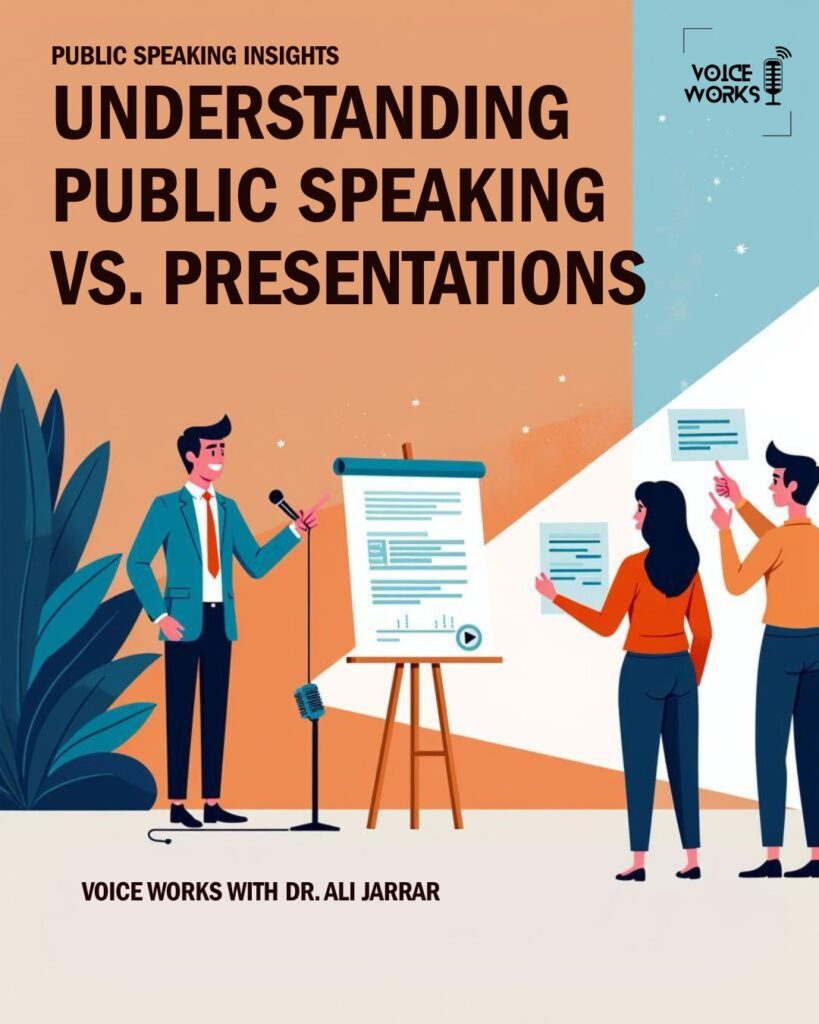
Many people use the terms public speaking and presentation interchangeably, but they are distinct forms of communication. Understanding the difference between public speaking and presentation can help professionals choose the right approach for their audience and purpose.
At Voice Works, Dr. Ali Jarrar helps professionals across Pakistan identify whether a public speaking approach or a structured presentation will be most effective for their communication goals. This guide will explain public speaking versus presentation, presentation versus speech, and types of public speaking and presentations.
Public Speaking Versus Presentation
Public speaking is a broader skill that involves engaging an audience through spoken communication. It often emphasizes storytelling, persuasion, or delivering an impactful message. Presentations usually involve structured content supported by visual aids such as slides, charts, or videos.
Understanding public speaking versus presentation allows you to adapt your style. For instance, a keynote speech at a conference requires audience engagement, while a quarterly business review might rely on clear visual aids.
Skills Needed for Public Speaking and Presentations
Professionals need different skill sets depending on whether they are delivering a speech or a presentation. Public speaking requires strong storytelling, confident body language, and audience engagement strategies. Presentations demand effective presentation techniques, clear visuals, and a logical flow of information.
Here’s a simple table summarizing the skills comparison:
| Skill Area | Public Speaking | Presentation |
| Storytelling | High importance | Moderate importance |
| Body Language | Essential | Important for engagement |
| Audience Interaction | High | Moderate |
| Visual Aids | Optional | Essential |
| Structure | Flexible | Highly structured |
In practice, combining these skills produces persuasive and informative speaking. Professionals who balance audience interaction with structured content deliver the most memorable performances.
Examples of Speech Versus Presentation
A motivational speech is an example of public speaking, focusing on inspiring and connecting with the audience through emotion and storytelling.
A project update presentation is an example of a structured presentation, emphasizing clarity, data, and informative content.
Analyzing speech versus presentation examples helps you identify when to adopt persuasive versus informative speaking and adjust your communication style for the audience.
Types of Public Speaking and Presentations
There are several types of public speaking and presentations. Formal communication styles, such as keynote speeches or corporate presentations, require structured delivery, rehearsed content, and a professional tone. Informal communication styles, such as team meetings or workshops, encourage interactive engagement and a conversational tone.
Understanding these types allows professionals to choose the right approach, whether delivering a persuasive message or sharing information effectively.
Case Study: Choosing the Right Approach
A real estate entrepreneur in Pakistan struggled to engage investors during property presentations. By learning the difference between public speaking and presentation, he structured his content with clear visuals while incorporating audience engagement strategies from public speaking.
The result was a highly effective session where investors were attentive, engaged, and impressed. This case highlights how mastering both skills produces confident, impactful communication.
Frequently Asked Questions
Q1. What is the main difference between public speaking and presentation?
Public speaking focuses on verbal delivery and audience engagement, while presentations emphasize structured content with supporting visuals.
Q2. Is a presentation considered public speaking?
Yes, a presentation can be a form of public speaking, but it relies more heavily on visuals and structured content than on audience engagement alone.
Q3. Which is more effective for engaging an audience: speech or presentation?
It depends on the goal. Speeches inspire and emotionally connect, while presentations inform and organize information logically. Combining both is often most effective.
Q4. What skills are needed for public speaking compared to presentations?
Public speaking requires storytelling, confidence, and audience interaction. Presentations need clear visuals, structured content, and logical flow of information.
Conclusion
Understanding the difference between public speaking and presentations empowers professionals to communicate effectively. Whether delivering a speech or a structured presentation, knowing when to engage the audience, use visuals, and balance persuasive versus informative speaking is crucial.
With guidance from Dr. Ali Jarrar and Voice Works, professionals across Pakistan can develop both public speaking and presentation skills to connect with audiences, deliver messages clearly, and leave lasting impressions. Mastering these skills allows you to communicate with confidence and impact in any professional setting.
Gracias!